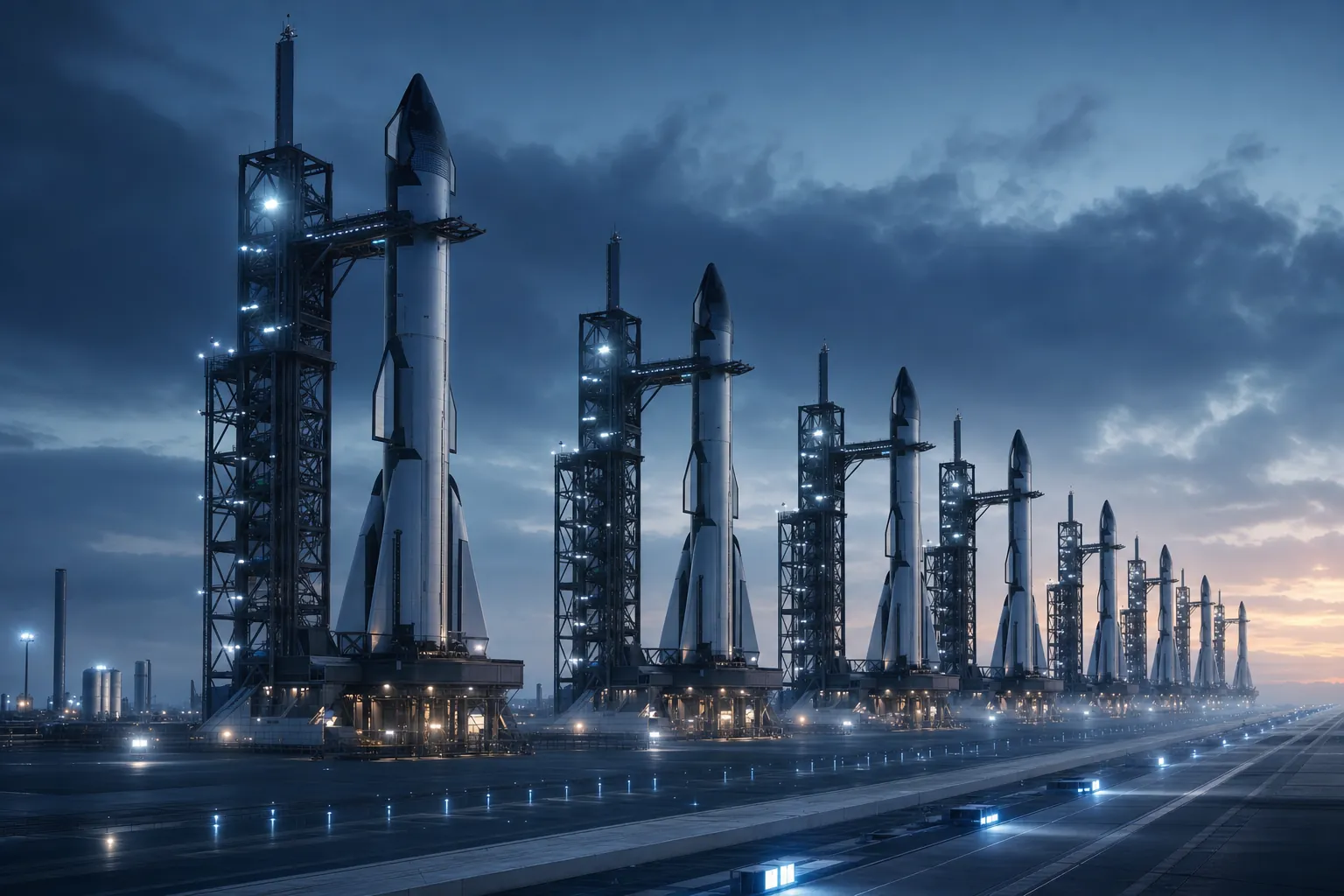
The mission
The case for pricing orbit like aviation
Cost per kilogram, the 2030 ISS deorbit, four commercial stations and an annual lunar cadence — what has to hold for access to orbit to become routine, and what is already true.
Orbit is in the middle of the transition aviation completed in the twentieth century: from a state-run demonstration of capability to a service with a price. This is the case for finishing that transition deliberately — and the evidence for where it currently stands.
The premise
Commercial aviation did not become ordinary because aircraft got faster. It became ordinary because the marginal cost of a seat collapsed — airframes flew thousands of times instead of once, ground operations became routine, and pricing followed. Spaceflight is early in the same transition, and the number that tracks it is cost per kilogram to low Earth orbit.
The historical benchmark is stark. The Space Shuttle cost roughly $54,500 per kilogram to low Earth orbit, and about $93,400 per kilogram when the destination was the International Space Station specifically. Falcon 9's advertised pricing already cut that to around $2,720 per kilogram. Projections for a fully reusable Starship carrying 100 tonnes at roughly $10 million a flight land near $100 per kilogram, and SpaceX's own 2019 operating-cost projection of about $2 million per launch implies figures as low as $20 per kilogram (SpaceDaily).
The claim in one line
Reusability, not thrust, is the variable that decides whether orbit stays a government program or becomes an industry — and the projected two-to-three orders of magnitude of cost reduction is what makes commercial access to a station a policy question rather than a fantasy.
The reality check
None of this is finished, and pretending otherwise is how credibility gets lost. Starship's ninth test flight, launched May 27, 2025, reached space but broke up over the Indian Ocean after a propellant leak, following mid-flight explosions on Flights 7 and 8 in January and March 2025. In a 42-minute presentation posted in late May 2025, Elon Musk nonetheless said SpaceX was still targeting a Mars mission in 2026, framing progress by "the timeline to establishing a self-sustaining civilization on Mars" (Space.com).
Public budgets are equally unsentimental. A compromise congressional spending bill in early 2026 effectively ended NASA's Mars Sample Return program, stating that "the agreement does not support the existing Mars Sample Return program" and leaving dozens of carefully cached Perseverance cores in limbo. Congress did redirect $110 million into a new "Mars Future Missions" line to keep key technologies moving, which the Planetary Society's Jack Kiraly said could let NASA "hit the reset button" on sample return later (Science.org).
An industry-grade case for affordable access has to survive both facts at once: the cost curve is real, and the schedule slips are real.
There is a clock on low Earth orbit
NASA and its partners have maintained a continuous human presence in low Earth orbit since November 2000, a streak soon reaching 25 years. The station that made it possible — first modules launched in 1998 — is scheduled to be deliberately deorbited into a remote area of the Pacific Ocean in 2030, after hosting more than 4,000 experiments and generating over 4,400 research publications (Space.com).
That deadline is what turns commercial stations from a business-plan slide into infrastructure. Four programs are visibly moving:
Axiom Station. In its 2025 Year in Review, Axiom Space said it "solidified [its] leadership in commercial human spaceflight," highlighted by Axiom Mission 4 — commanded by Peggy Whitson and carrying the first-ever government astronauts from India, Poland, and Hungary on an 18-day flight that ran more than 60 experiments representing 31 nations — while revising its station assembly sequence toward a free-flying outpost (Axiom Space).
Orbital Reef and Haven. Blue Origin and Sierra Space's Orbital Reef — backed by Boeing, Amazon, Redwire and Genesis Engineering — completed a NASA System Definition Review and entered its design phase with an operational target around 2027, while Vast began hardware integration on Haven-1 as a stepping stone to the multi-module Haven-2, pitched as an affordable ISS successor for microgravity research and manufacturing (Blue Origin, Vast Space).
Starlab. Voyager Technologies is taking the opposite architectural bet from the ISS: launch the platform whole rather than assemble it incrementally, so research can begin from day one — a philosophy grounded in heritage from more than 1,400 missions and 12 active ISS research facilities, including the Bishop Airlock, the first commercial airlock on the station (Voyager Technologies).
What routine already looks like
Crewed operations are quietly becoming ordinary. SpaceX's Polaris Dawn — the first of Jared Isaacman's three-flight Polaris Program, launched in partnership with St. Jude Children's Research Hospital — flew a four-person crew for nearly five days and 75 orbits aboard Crew Dragon Resilience in September 2024, including the first-ever commercial spacewalk (Wikipedia).
“Spaceflight has been around now for 60 years, but we're in a revolution right now of reusable spaceship design, which is drastically dropping the cost, which then increases the access for everybody... right now, it's possible to just buy a ticket and go to space for the price of a luxury car.”
Government programs are also being restructured for cadence rather than spectacle. NASA's updated Artemis architecture standardizes vehicle configuration and commits to at least one crewed lunar surface landing every year starting with Artemis IV in 2028; Artemis II is set to fly astronauts around the Moon with launch opportunities in April, and NASA added a mission ahead of a 2027 Artemis III flight to test rendezvous and docking with commercial landers from SpaceX and Blue Origin in low Earth orbit before the crewed landing (NASA).
Cadence is the tell. Aviation became safe and cheap because it repeated; annual landings and standardized vehicles are the same mechanism applied to deep space.
Where affordability will not come from
Suborbital tourism is not the path. Virgin Galactic resumed suborbital ticket sales in March 2026 at $750,000 per seat after a two-year hiatus (Bloomberg). A few minutes above the atmosphere at three-quarters of a million dollars is a luxury good, not transport infrastructure.
Real affordability comes from reusable orbital vehicles flying often, with destinations worth going to. That is why launch cost, station availability and flight rate matter more to this argument than ticket-price headlines.
The public-legitimacy problem
Spending on orbit is also a political argument, and it is fought on contested ground: whether Apollo happened, whether the ISS is real, whether the money is "wasted in space" at all. Chris Hadfield's answer is the useful one — NASA's budget "is not spent in space but right here on Earth, where it's invested in American businesses and universities" (Goodreads). That is why myth-busting is a core section of this site, not a sideshow.
The science keeps paying out
Access and instrumentation compound. Researchers announced that the James Webb Space Telescope captured a direct image of a young, Saturn-sized gas giant orbiting a small star roughly 110 light-years away in the constellation Antlia — the least massive exoplanet ever directly imaged, using a French-engineered coronagraph on Webb's Mid-Infrared Instrument. Fewer than 2% of the nearly 5,000 exoplanets found since the 1990s have been captured through direct imaging (Reuters).
Cheaper mass to orbit means larger apertures, more spacecraft, faster iteration and shorter gaps between question and instrument. The cost curve is a science-throughput argument as much as an economic one.
What we hold ourselves to
This site is an editorial project with a bias it states openly: affordable orbital access is worth pursuing. The bias does not extend to the facts. Every claim links to the agency, operator, transcript or publication that reported it. Quotations are reproduced verbatim with speaker, work and date. We publish no synthetic photographs of real people, and no invented figures.
“I am proud to be part of a species where a subset of its members willingly put their lives at risk to push the boundaries of our existence.”
If the cost floor holds near $100 per kilogram, a commercial station is operating before 2030, and lunar landings settle into an annual rhythm, then the interesting question stops being whether ordinary people reach orbit and becomes what they do when they get there. That is the transition FlyISS is here to document — dispatch by dispatch and voice by voice.
Procedural orbital model · station in a 51.6°-style inclined orbit
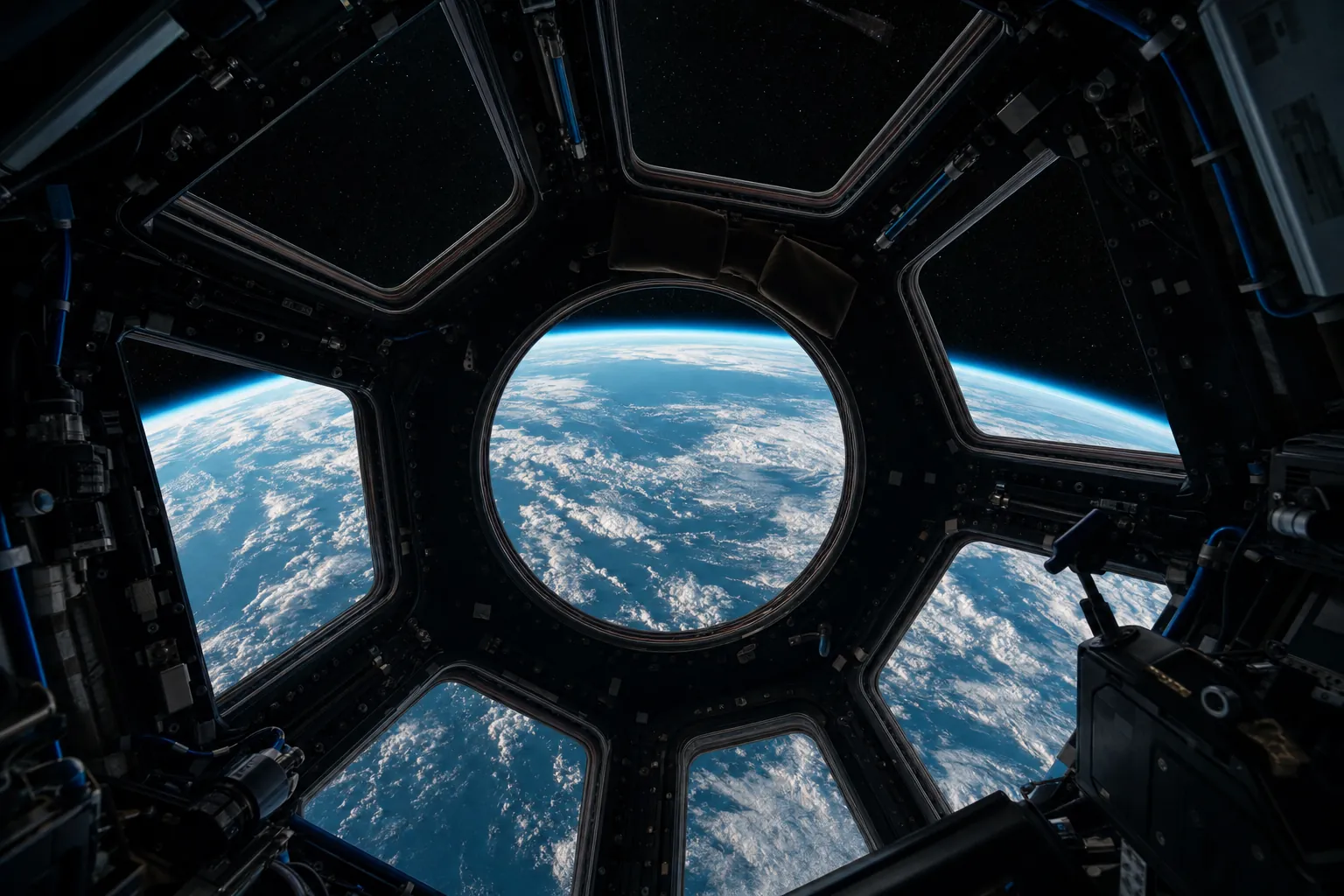
Join the mission
Hold us to the sourcing standard.
One dispatch a week on launch economics, station programs and claims worth correcting.
Preview only — the dispatch list is not connected yet, so nothing is stored or sent.